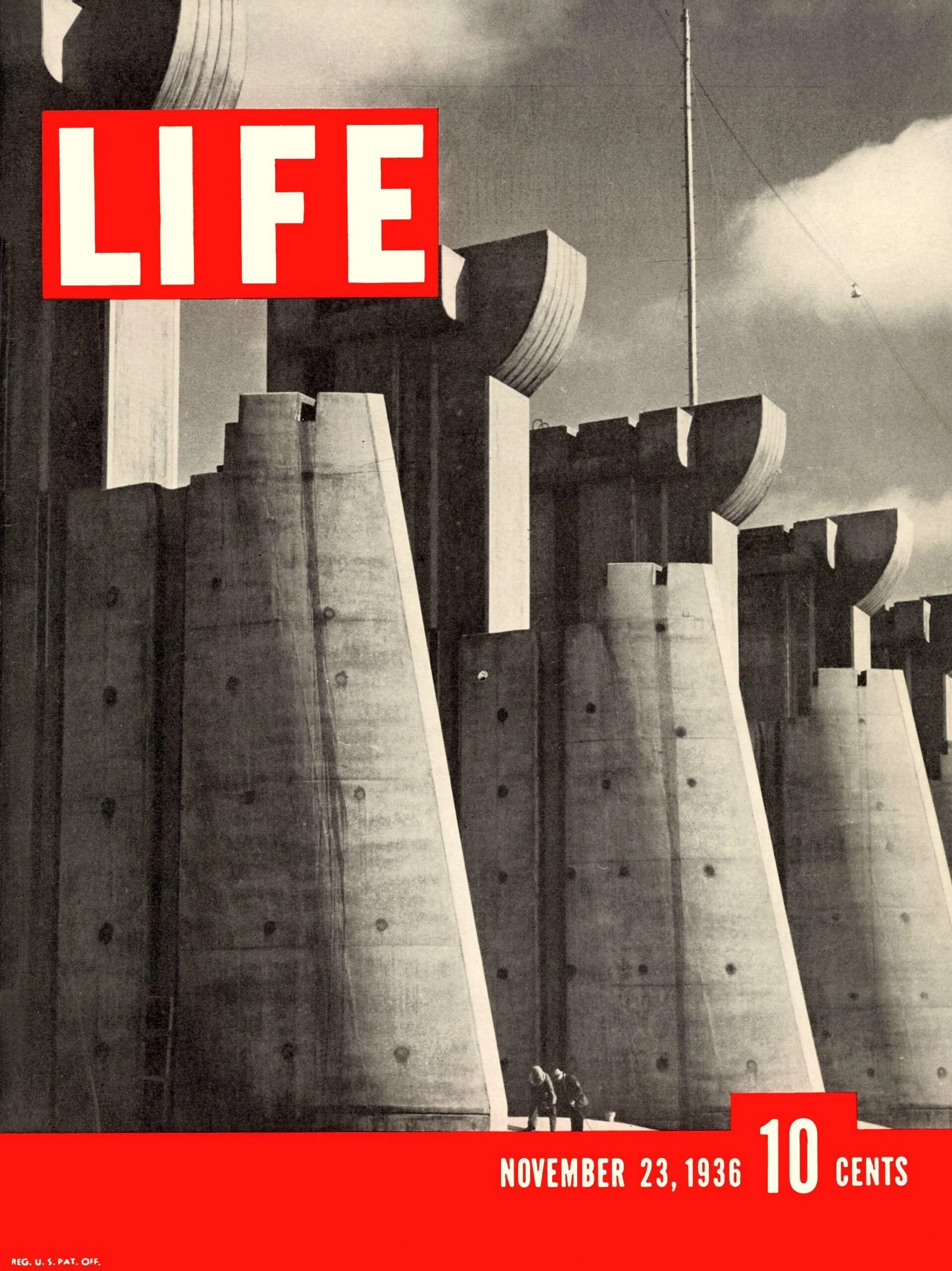
The massive construction projects, thousands of workers, and extraordinary photographs that helped launch LIFE Magazine — 90 years ago this November. On November 23, 1936, a new magazine appeared on American newsstands. Its cover did not feature a movie star, a president, or a famous athlete. Instead, it showed an enormous concrete structure rising against the Montana sky. Two tiny figures stood at its base, dwarfed by the scale of the construction surrounding them. The photograph, taken by Margaret Bourke-White, showed the spillway of Fort Peck Dam, one of the most ambitious engineering projects in American history. It was the very first cover of LIFE Magazine. And on November 23, 2026, that remarkable issue will celebrate its 90th anniversary. It was an appropriate beginning for a magazine that would spend decades documenting the people, places, and events that shaped modern America.
Building a Nation During the Great Depression
In 1933, America was in the depths of the Great Depression. Millions were unemployed. Businesses had failed. Factories stood idle. Families struggled to survive. President Franklin D. Roosevelt’s New Deal launched an ambitious program of public construction, putting Americans to work building roads, bridges, dams, and other infrastructure. Among the largest projects was Fort Peck Dam on the Missouri River in northeastern Montana. The undertaking was enormous. Engineers planned to construct one of the world’s largest earth-filled dams, requiring extraordinary amounts of earthmoving, equipment, materials, and manpower. Construction began in 1933. Workers arrived from across the country, many desperate for employment after years of economic hardship. By 1936, more than 10,000 people were working directly on the dam. For thousands of families, Fort Peck represented something more important than an engineering achievement. It represented a paycheck.
The Towns That Rose Around the Dam
The construction project transformed a remote part of Montana. Workers needed places to sleep, eat, shop, and spend their wages. Temporary settlements and boomtowns appeared across the surrounding countryside. Restaurants, boardinghouses, stores, bars, and other businesses sprang up almost overnight. Families followed the workers. Entrepreneurs followed the paychecks. Life could be difficult. Housing was often makeshift. Construction work was demanding. The weather could be unforgiving, and the communities surrounding the project were sometimes rough. But the promise of steady employment drew people from across America. The dam was not simply a construction site. It had become an economic engine for an entire region.
Margaret Bourke-White and the First LIFE Cover
When photographer Margaret Bourke-White traveled to Montana in 1936, she was expected to document the enormous federal construction projects underway in the West. She photographed the machinery, the engineering, and the immense structures taking shape. But she also photographed the people. Her images captured workers, crowded settlements, makeshift housing, and the rough-and-tumble communities that had emerged around the project. LIFE’s editors had expected an impressive story about construction. What they received was something more revealing: a portrait of American life during one of the country’s most difficult periods. The photograph chosen for LIFE’s first cover was extraordinary. Massive concrete spillway supports towered above two small workers, creating an image that communicated the scale of the project immediately. It was dramatic, unmistakable, and unlike the typical magazine cover of its day. The photograph announced something important about LIFE’s new approach to journalism. Pictures would not merely illustrate the news. They would help tell the story.
The Dams That Helped Build Modern America
Fort Peck was part of a much larger transformation of the American landscape. Across the country, enormous public works projects were changing what America could accomplish. Hoover Dam, completed in 1936, helped provide water and electricity to the growing Southwest. Grand Coulee Dam in Washington, under construction during the same period, would become a major source of hydroelectric power and irrigation water. The Tennessee Valley Authority built dams that brought electricity, flood control, and economic development to parts of the rural South. These projects helped create jobs during the Depression while laying the groundwork for decades of growth. Electricity reached communities and industries that had previously lacked reliable power. Water supplies supported expanding cities and agriculture. Flood-control systems reduced risks in many river valleys. Hydroelectric plants helped power factories, homes, and wartime production. The dams themselves were enormous achievements. But their influence extended far beyond the concrete, steel, and earth used to construct them. They helped reshape where Americans lived, worked, and built their futures.
The Human Cost of Building Big
These accomplishments were not without costs. The work could be dangerous, and some workers lost their lives. At Fort Peck, a massive slide in 1938 killed eight workers. Large dams also permanently changed rivers, flooded landscapes, disrupted ecosystems, and affected communities whose connections to the land stretched back generations. Those consequences are part of the history too. The story of American infrastructure is not simply one of technological triumph. It is also a story of difficult choices, extraordinary labor, and changes whose effects lasted long after construction crews departed.
Ninety Years of LIFE Magazine
When LIFE’s first issue appeared on November 23, 1936, few readers could have imagined the extraordinary photographic record the magazine would create. Over the following decades, LIFE would document World War II, the postwar economic boom, the civil rights movement, the space race, presidential elections, cultural revolutions, and countless moments of everyday American life. Its photographers would capture history as it unfolded. But it all began with a photograph of a dam under construction in Montana. Not a celebrity. Not a politician. A massive public works project, and two ordinary Americans standing beneath it. There is something fitting about that choice. Modern America was built by engineers and inventors, certainly. But it was also built by construction crews, electricians, welders, equipment operators, truck drivers, and thousands upon thousands of workers whose names rarely appeared in history books. LIFE helped preserve their world. And 90 years later, its first issue remains a reminder of what photographs can tell us about the people who built a nation.
Explore the Original LIFE Issue
LIFE Magazine — November 23, 1936 The historic first issue of LIFE Magazine, featuring Margaret Bourke-White’s iconic Fort Peck Dam spillway photograph. Inside, readers discovered the original coverage of the Montana construction project and the workers’ communities, alongside the news, photography, culture, and advertisements of November 1936. An extraordinary surviving record of both American history and the beginning of one of the country’s most influential magazines.
View the original November 23, 1936 issue: https://www.originallifemagazines.com/product/life-magazine-november-23-1936/
How America Was Built American Industry Through the Pages of LIFE This series explores the industries, infrastructure, workers, and communities that shaped twentieth-century America through the photographs, stories, advertisements, and people preserved in LIFE Magazine. Original LIFE Magazines — authentic issues published between 1936 and 2000. OriginalLIFEmagazines.com Stories worth preserving — History you can hold.