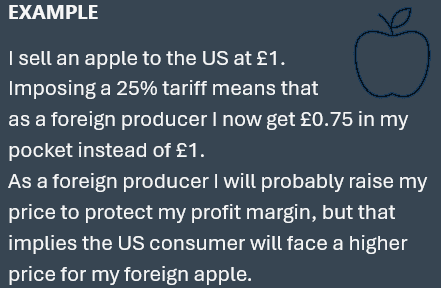
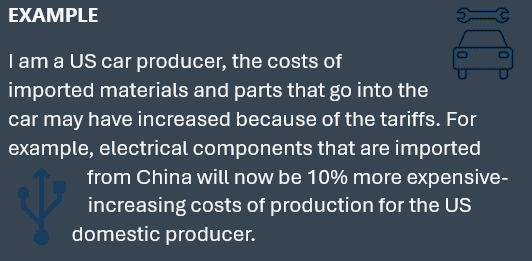
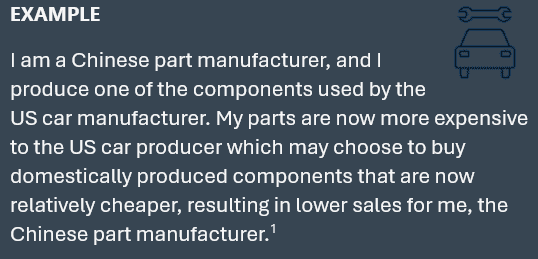
Tariffs are taxes imposed by a government on goods and services imported from other countries. Think of tariff like an extra cost added to foreign products when they enter the country. They’re usually a percentage of the price of the goods. The level of the tariff will affect the significance of its impacts. Why do governments impose tariffs:
Raise government revenue– tariffs serve as a source of income for governments.
Protect domestic industries and correct trade imbalances– tariffs shelter domestic industries from foreign competition and discourage consumption of imported goods.
Political tool for negotiations– tariffs can be used to apply pressure on the foreign government they are imposed on, as part of a trade negotiation or a political tool.
For example, the Trump administration has justified imposing tariffs on Canada, Mexico and China, to pressure foreign governments into addressing illegal immigration and drug trafficking, while also addressing the size of the country’s trade deficit.
What impact do tariffs have on the economy imposing them?
Domestic industries may benefit from reduced foreign competition. If foreign goods are now relatively more expensive, this would drive up demand for domestic products, allowing domestic industries to expand and increase production. However, some domestic industries have global supply chains that rely on imported materials and parts. As prices of imported materials and parts increase, domestic producers may face higher costs of production. If the domestic producers pass higher costs of production onto consumers, it will also push up prices of domestically produced goods. Notably, the economies that are initially ‘tariff imposers’ may end up facing retaliatory tariffs, which has been the case in the current climate. Below we highlight some potential tariff impacts on the economies tariffs are imposed on. What impact do tariffs have on the economies they are imposed on?
In the country that tariffs are imposed on targeted industries will face lower export demand. As their goods have become relatively more expensive in the importing country, it will lead to lower sales and lost market share, as consumers switch to relatively cheaper domestic goods. The degree of this decline depends on the price elasticity of demand, how much consumers adjust their purchases of imports in response to the higher prices caused by the tariffs. This may be the case for example if there are few alternatives in the domestic market, or consumers have a strong brand preference. The extent of the impact will depend on how much of the country’s production is exports, and particularly, exports to the country imposing the tariff. In Canada, for example, exports make up 33% of Gross Domestic Product and exports to the US specifically are 20% of Gross Domestic Product. Industries in countries that tariffs are imposed on may adjust their export strategies to minimize losses, by seeking other markets to sell to with more favourable tariff regimes. Yet, redirecting trade to alternative markets comes with its challenges: including regulatory barriers, logistics and distribution costs – establishing new supply chains takes time and investment, and existing competition may be well established in alternative markets.
Pop-Tarts Frosted Strawberry flavor Pop-Tarts Product type Toaster pastry Owner Kellanova Country United States Introduced September 14, 1964; 59 years ago Related brands Pop-Tart Bites, Pop-Tart Crisps, Pop-Tart Cereal Markets Worldwide Previous owners Kellogg’s (1964–2023) Tagline “Crazy Good!” Website poptarts.com Pop-Tarts (stylized... read more
Sharon Tate Tate in 1969 Born Sharon Marie Tate January 24, 1943 Dallas, Texas, U.S. Died August 9, 1969 (aged 26) Los Angeles, California, U.S. Cause of death Murder by stabbing Burial place Holy Cross Cemetery,... read more
A United States Space Command impression of a conceptual satellite-based directed-energy weapon used to precisely strike targets on Earth Space weapons are weapons used in space warfare. They include weapons... read more
Members of the Reichstag salute Adolf Hitler, dictator of Nazi Germany from 1933 to 1945 Part of the Politics series Basic forms of government List of forms of government List... read more