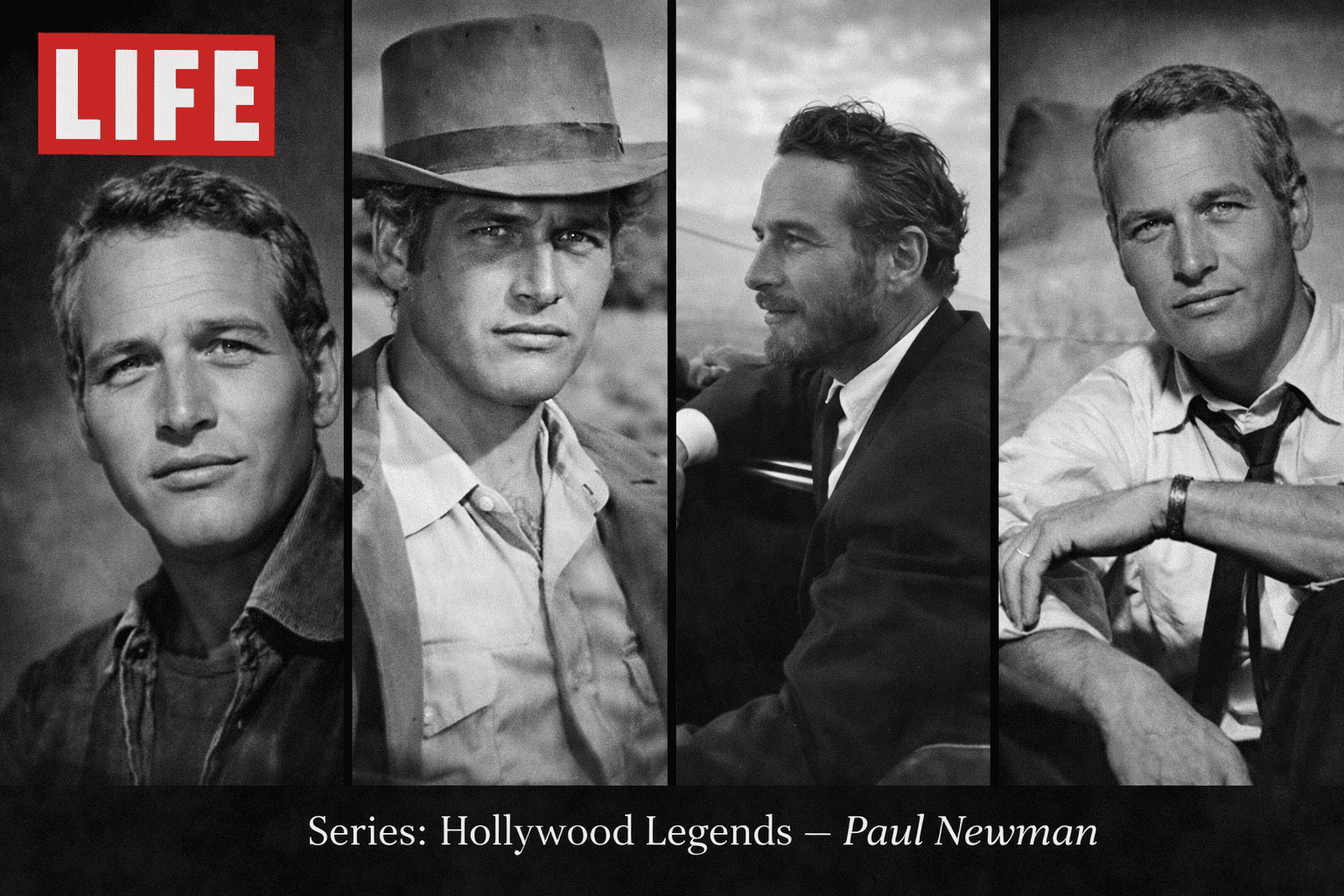
From Hollywood Icon to Racing Champion to Quiet Philanthropist
Some stars demand attention. Others earn it. Paul Newman never demanded anything. He didn’t arrive in Hollywood with noise or scandal or hunger for conquest. He arrived quietly — with discipline, doubt, ambition, and a deep belief that fame was something to be handled carefully, like a volatile chemical. Those famous blue eyes made him visible. His character made him unforgettable. Some actors become legends because they burn brightly. Newman became one because he burned steadily.
The Slow Construction of a Star
Born in 1925 in Shaker Heights, Ohio, Newman grew up far from glamour. His father ran a sporting-goods store. His mother encouraged culture and theater. He learned early that life was something you built, not something you stumbled into. World War II interrupted everything. Newman joined the U.S. Navy and trained as a rear gunner. A training accident grounded him before deployment. He never saw combat — a fact that quietly haunted him. He felt he hadn’t “earned” survival the way others had. That sense of unfinished obligation never left him. After the war, he studied at Yale, then at the Actors Studio. He failed. Rebuilt. Failed again. Worked harder. He wasn’t a prodigy. He was a craftsman. When success finally came in the 1950s, he wasn’t young. He wasn’t naïve. He wasn’t disposable. He was ready.
This Is the Next Post in the Series
Hollywood Legends as Photographed by LIFE Magazine
Newman’s rise coincided with a moment when America was searching for a new kind of hero. The old studio gods were fading. The war had changed people. Certainty was dissolving. Audiences wanted men who looked strong — and thought deeply. Paul Newman gave them both.
A Different Kind of Leading Man
Hollywood had always loved handsome men. But Newman’s beauty was complicated. It wasn’t ornamental. It wasn’t theatrical. It wasn’t desperate. It was grounded. He could play anger without cruelty. Confidence without arrogance. Sadness without sentimentality. In
The Hustler,
Cool Hand Luke,
Hud,
Butch Cassidy and the Sundance Kid, and
The Verdict, he created a new archetype: The decent rebel. The thoughtful outlaw. The principled survivor. Where others posed, Newman inhabited. Where others performed masculinity, Newman questioned it. He made vulnerability masculine — decades before it became fashionable.
LIFE Understood Him Immediately
When LIFE placed Paul Newman on its cover, it wasn’t crowning a heartthrob. It was documenting a moral presence. The camera didn’t exaggerate him. It didn’t glamorize him. It didn’t distort him. It observed him. On those covers, Newman doesn’t look like a movie star. He looks like a man who knows who he is. That is why they endure. They don’t feel like artifacts. They feel like encounters.
Paul Newman on the Cover of LIFE - May 10, 1968 — The Political Moment
- October 18, 1968 — Partnership and Power (with Joanne Woodward)
- November 1986 — Legacy and Mentorship (with Tom Cruise)
- September 1988 — Philanthropy and Purpose (Dream Camp)
Four covers. Four chapters. Each documents not reinvention — but evolution. From public conscience, to private partnership, to professional legacy, to moral leadership. He did not change who he was. He expanded it.
Fame Without Collapse
Hollywood destroys people. It rewards ego. It punishes reflection. It amplifies weakness. Newman refused the script. He married Joanne Woodward in 1958 and stayed married for fifty years — an almost unimaginable feat in his profession. He avoided scandal. Avoided exhibition. Avoided excess. He drank. He struggled. He admitted failure. He didn’t curate perfection. He practiced honesty. In later years, he spoke openly about regret — about being distant as a father, about mistakes he could not undo, about the cost of ambition. He never pretended he was flawless. That made him trustworthy.
The Second Life: Speed and Service
Most stars fade. Newman expanded. He discovered racing — and took it seriously. He trained. He competed. He earned respect. He raced at Le Mans. He built real teams. Then he founded Newman’s Own. Salad dressing. Pasta sauce. Lemonade. And then he gave the money away. All of it. By the time he died, more than
$570 million had been donated to charity. Children’s camps. Education programs. Civil rights initiatives. Medical research. Quietly. No slogans. No branding. No spectacle. Just responsibility.
The Meaning of Staying
In a culture obsessed with reinvention, Newman chose continuity. He stayed married. Stayed reflective. Stayed useful. Stayed human. He did not confuse fame with purpose. That may be his greatest achievement.
Ten Things You Might Not Know About Paul Newman
- He once considered quitting acting early in his career.
- He struggled with imposter syndrome for decades.
- He kept private journals throughout his life.
- He disliked Hollywood publicity culture.
- He competed professionally in endurance racing.
- He never took a salary from Newman’s Own.
- He feared becoming morally complacent.
- He avoided political grandstanding.
- He believed fame was dangerous if untreated.
- He defined success as “leaving things better.”
Paul Newman didn’t chase greatness. He cultivated it.