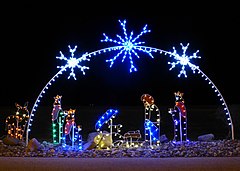
Gift-giving, family and other social gatherings, symbolic decoration, feasting
Observances
Church services
Date
December 25 (Western Christianity and part of the Eastern churches)
January 6 (Armenian Apostolic Church and the Armenian Evangelical Church)
January 7 (O.S. December 25) (most Oriental Orthodox and part of the Eastern Orthodox churches)
January 19 (O.S. January 6) (Armenian Patriarchate of Jerusalem)
Related to
Christmastide, Christmas Eve, Advent, Annunciation, Epiphany, Baptism of the Lord, Nativity Fast, Nativity of Christ, Old Christmas, Yule, St. Stephen’s Day, Boxing Day
Christmas is an annual festival commemorating the birth of Jesus Christ, observed primarily on December 25 as a religious and cultural celebration among billions of people around the world. A liturgical feast central to Christianity, preparation for Christmas begins on the First Sunday of Advent and it is followed by Christmastide, which historically in the West lasts twelve days and culminates on Twelfth Night. Christmas Day is a public holiday in many countries, is celebrated religiously by a majority of Christians, as well as culturally by many non-Christians, and forms an integral part of the holiday season surrounding it.
The traditional Christmas narrative recounted in the New Testament, known as the Nativity of Jesus, says that Jesus was born in Bethlehem, in accordance with messianic prophecies. When Joseph and Mary arrived in the city, the inn had no room, and so they were offered a stable where the Christ Child was soon born, with angels proclaiming this news to shepherds, who then spread the word.
There are different hypotheses regarding the date of Jesus’s birth. In the early fourth century, the church fixed the date as December 25, the date of the winter solstice in the Roman Empire. It is nine months after Annunciation on March 25, also the Roman date of the spring equinox. Most Christians celebrate on December 25 in the Gregorian calendar, which has been adopted almost universally in the civil calendars used in countries throughout the world. However, part of the Eastern Christian Churches celebrate Christmas on December 25 of the older Julian calendar, which currently corresponds to January 7 in the Gregorian calendar. For Christians, believing that God came into the world in the form of man to atone for the sins of humanity rather than knowing Jesus’s exact birth date is considered to be the primary purpose of celebrating Christmas.
The customs associated with Christmas in various countries have a mix of pre-Christian, Christian, and secular themes and origins. Popular holiday traditions include gift giving; completing an Advent calendar or Advent wreath; Christmas music and caroling; watching Christmas movies; viewing a Nativity play; an exchange of Christmas cards; attending church services; a special meal; and displaying various Christmas decorations, including Christmas trees, Christmas lights, nativity scenes, garlands, wreaths, mistletoe, and holly. Additionally, several related and often interchangeable figures, known as Santa Claus, Father Christmas, Saint Nicholas, and Christkind, are associated with bringing gifts to children during the Christmas season and have their own body of traditions and lore. Because gift-giving and many other aspects of the Christmas festival involve heightened economic activity, the holiday has become a significant event and a key sales period for retailers and businesses. Over the past few centuries, Christmas has had a steadily growing economic effect in many regions of the world.
Timeless icon of Italian glamour, Sophia Loren blended sensual beauty with authentic, strong-willed performances and proved that elegance could... read more
Clarissa Hahn
Economist
What are tariffs?
Tariffs are taxes imposed by a government on goods and services imported from other countries. Think... read more
Ukraine
Україна (Ukrainian)
Flag
Coat of arms
Anthem: Державний Гімн України
Derzhavnyi Himn Ukrainy
“State Anthem of Ukraine”
Show globeShow map of EuropeTopographic map of Ukraine, with
borders, cities... read more
Maude E. Callen (November 8, 1898[1] in Quincy, Florida – January 23, 1990[1] in Pineville, South Carolina[2]) was a nurse-midwife in the South Carolina Lowcountry for... read more
“Anyone who thinks they’re too small to make a difference has never met the honeybee.”
– Popular saying, unknown attribution
Background
Scientists... read more