Lee Miller: The War Photographer Who Made Denial Impossible
Lee Miller did not begin as a war photographer.
She began in front of the camera.
A model.
A surrealist.
An artist.
A woman who understood image, beauty, composition, and illusion before she ever stepped onto a battlefield.
Then came World War II.
And Miller turned her eye toward something beauty could not soften: war.
For the companion Substack essay on Lee Miller, read the full piece here:
https://originallifemagazines.substack.com/p/series-war-photographers-lee-miller
Not war as strategy.
Not war as glory.
War as destruction.
War as evidence.
War as the thing people later try to deny.
From Surrealism to War
Before the war, Lee Miller had already lived several lives.
She had worked in Paris with Man Ray, helped shape surrealist photography, and developed an eye for shadow, framing, and psychological unease. That mattered later.
Because when Miller reached the war, she did not photograph it as a distant observer.
She photographed it with an artist’s eye — and a witness’s urgency.
Her images were composed, but never softened. They were artful, but never decorative. They forced the viewer to understand that history is not only written by armies. It is preserved by witnesses.
Lee Miller and the Blitz
When German bombs fell on London, Miller was living in Britain. She could have returned to America.
She did not.
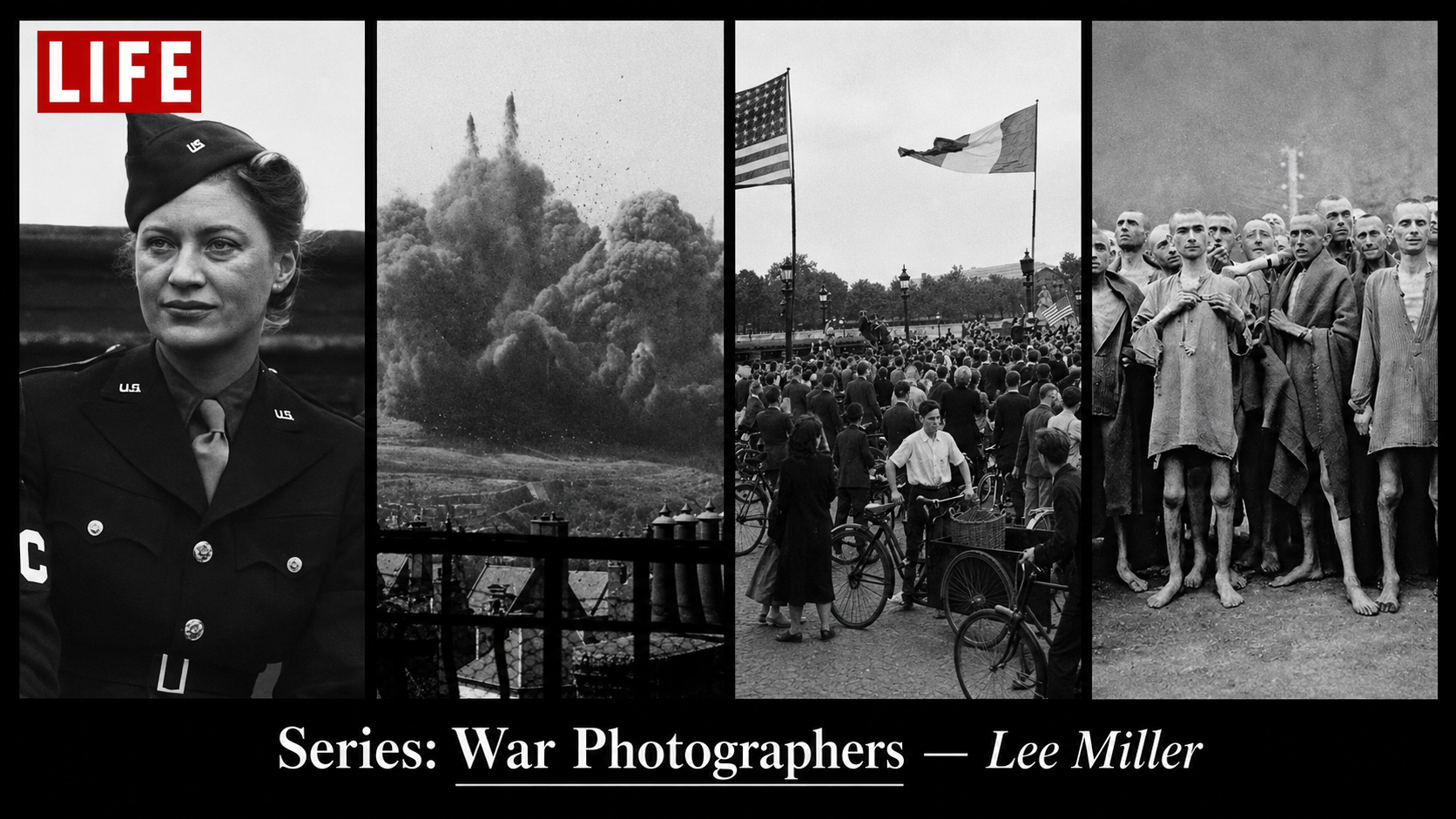
Instead, she documented the Blitz for Vogue, showing a city under attack: streets torn open, buildings reduced to rubble, civilians living inside destruction, and ordinary life continuing under extraordinary threat.
This was not battlefield photography in the traditional sense.
But it was war.
War in bedrooms.
War in churches.
War in city streets.
War in the lives of people who never chose it.
Into Europe After D-Day
After D-Day, Lee Miller followed the Allied advance across Europe as an accredited war correspondent.
She photographed Saint-Malo under siege.
She photographed the liberation of Paris.
She photographed soldiers, civilians, prisoners, ruined towns, and the strange silence that follows bombardment.
Her images were not sentimental.
They were direct. Sometimes cold. Sometimes almost surreal.
That was part of their power.
Miller understood that war often looks unreal because it is morally unreal. A city may still stand. A window may still frame the sky. A room may still have wallpaper.
And yet everything human has been shattered.
Dachau, Buchenwald, and the Camera as Evidence
Lee Miller’s most important war work came near the end of World War II.
In 1945, she photographed the liberated concentration camps at Buchenwald and Dachau.
These were not images of battle.
They were images of consequence.
Bodies.
Survivors.
Barracks.
The machinery of atrocity.
The proof.
Miller understood that the camera had become more than a tool of journalism. It had become evidence.
Her photographs said:
This happened.
People did this.
Do not look away.
Do not forget.
Lee Miller in Hitler’s Bathtub
Lee Miller’s wartime path also crossed closely with David E. Scherman, the LIFE Magazine photographer and correspondent.
Together, they documented some of the final, devastating scenes of the war in Europe. Scherman photographed one of the most famous images of Miller: Lee Miller sitting in Adolf Hitler’s bathtub in Munich on April 30, 1945 — the same day Hitler died.
The image is unsettling because of its contradictions.
A woman.
A bathtub.
A private apartment.
A pair of boots carrying the dirt of Dachau.
It is not a glamorous image.
It is an accusation.
The war had reached the dictator’s private rooms. And Miller, who had seen what his regime had done, occupied that space with silent contempt.
Lee Miller, LIFE Magazine, and the Visual Record of World War II
Lee Miller was not a LIFE staff photographer. She worked primarily for Vogue.
But her work belongs beside LIFE’s wartime visual record because it shared the same essential purpose: to show the public what words alone could not carry.
LIFE Magazine helped define how Americans saw World War II. Miller helped define how the war should be remembered.
For collectors and readers, original LIFE issues from 1944 and 1945 offer a direct connection to that moment — the final Allied advance, the liberation of Europe, and the first public photographic reckoning with the Nazi camps.
Featured LIFE Magazine Issue: May 7, 1945
The essential LIFE issue for this story is the May 7, 1945 issue of LIFE Magazine.
Its feature, “Atrocities: Capture of the German concentration camps piles up evidence of barbarism,” presented American readers with graphic photographic evidence from the liberated camps.
That issue remains one of LIFE’s most important wartime documents — not because it celebrates victory, but because it forces readers to confront what victory uncovered.
Lee Miller was creating her own visual testimony in Europe at the same time.
Different magazine.
Same moral purpose.
To make denial impossible.
👉 Collect the May 7, 1945 issue here:
https://www.OriginalLIFEmagazines.com/product/life-magazine-may-7-1945/
Other Related 1945 LIFE Magazine Issues
For collectors looking at the full arc of how LIFE documented the end of World War II and the unfolding truth of the Holocaust, these related issues also matter.
April 30, 1945 — LIFE Magazine
As Allied forces pushed deeper into Germany, LIFE was already documenting the collapse of the Nazi state and the first shocking evidence emerging from the German interior.
👉 Collect the April 30, 1945 issue here:
https://www.OriginalLIFEmagazines.com/product/life-magazine-april-30-1945/
May 14, 1945 — LIFE Magazine
This is LIFE’s V-E Day issue — a victory issue, but not a simple celebration. It belongs to the same historical arc because the defeat of Germany also forced the world to confront what Allied armies had uncovered.
👉 View the May 14, 1945 issue here:
https://www.OriginalLIFEmagazines.com/product/life-magazine-may-14-1945/
May 21, 1945 — LIFE Magazine
This follow-up issue continued LIFE’s coverage of postwar Europe, the occupation, and the physical and moral wreckage left behind after the collapse of the Third Reich.
👉 Collect the May 21, 1945 issue here:
https://www.OriginalLIFEmagazines.com/product/life-magazine-may-21-1945/
Why Lee Miller Still Matters
Lee Miller’s legacy is not simply that she was a woman war photographer in a field dominated by men.
That matters.
But it is not the whole story.
Her importance lies in what she saw — and what she refused to let others avoid.
She photographed war at its most human and most inhuman:
the bombed city,
the liberated street,
the ruined home,
the concentration camp,
the dictator’s bathroom.
Her work remains one of the most powerful visual records of World War II because it understands something essential:
history is not only made by armies.
It is preserved by witnesses.
For Collectors and Readers
Original 1945 LIFE Magazine issues are not just collectibles.
They are historical artifacts.
They are evidence printed on paper.
The May 7, 1945 issue remains the defining LIFE Magazine artifact for this story. The surrounding issues — April 30, May 14, and May 21 — help complete the arc.
The approach.
The revelation.
The victory.
The reckoning.
Together, they show how LIFE documented not only the end of the war, but the truth the war exposed.
👉 Collect original LIFE Magazines at:
https://www.OriginalLIFEmagazines.com
History you can hold.
Original LIFE Magazines are authentic issues published between 1936 and 2000.
Available at OriginalLIFEmagazines.com.
The perfect milestone gift.
Stories worth preserving – History you can hold.