Lech Wałęsa and Solidarity: The Electrician Who Challenged an Empire
How an ordinary worker helped turn a shipyard strike into a movement that changed Poland—and Europe
There are moments in history when courage does not come from a palace.
It does not wear a uniform.
It does not command an army.
Sometimes it carries a toolbox.
Sometimes it climbs a shipyard fence.
And sometimes it belongs to an electrician who looks at one of the most powerful authoritarian systems in the world and decides that ordinary people deserve a voice.
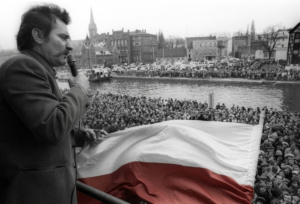
In August 1980, Lech Wałęsa entered the Lenin Shipyard in Gdańsk, Poland, where workers had gone on strike against the country’s communist government.
Independent labor unions were forbidden. The government controlled the factories, the media, the police and nearly every institution capable of challenging its authority.
Public dissent could cost a person a job, freedom or life.
But the workers had reached a breaking point.
They wanted better wages and safer working conditions. They wanted dismissed employees reinstated. They wanted freedom of speech and the release of political prisoners.
Above all, they wanted the right to organize independently of the government.
Wałęsa did not arrive as a general, politician or statesman.
He arrived as one of them.
A worker.
An electrician.
A man who understood that when ordinary people stand together, even a government built on fear can begin to tremble.
The Gdańsk Shipyard Strike of 1980
The strike began on August 14, 1980, after crane operator and labor activist Anna Walentynowicz was fired shortly before she was due to retire.
Her dismissal became a symbol of the government’s treatment of workers who dared to speak out.
Wałęsa had also been fired from the shipyard because of his union activities. When the strike began, he made his way inside and quickly emerged as one of its most visible leaders.
The workers occupied the shipyard.
Government officials attempted to isolate them.
Telephone lines were cut. State-controlled media tried to suppress or shape the story. The possibility of police or military intervention hung over every meeting.
The danger was not theoretical.
In December 1970, Polish security forces had opened fire on protesting workers along the Baltic coast. People had been killed and wounded.
Wałęsa knew what could happen.
So did the workers beside him.
They continued anyway.
What began as a dispute inside one shipyard soon spread to factories, mines, rail yards and industrial plants across Poland.
Workers formed the Inter-Factory Strike Committee and developed 21 demands. These included the right to strike, freedom of speech, the release of political prisoners and the creation of independent trade unions.
It was a profound challenge to communist authority.
A government that claimed to rule in the name of the working class was now being confronted by the workers themselves.
The Birth of the Solidarity Movement
On August 31, 1980, representatives of the Polish government and the striking workers signed the Gdańsk Agreement.
The workers had won the right to establish an independent trade union.
It became known as Solidarność.
Solidarity.
The name captured the movement’s central belief.
One worker could be fired.
One protester could be arrested.
One factory could be surrounded.
But millions of citizens acting together could no longer be dismissed as isolated troublemakers.
Solidarity grew with extraordinary speed. By 1981, the movement had approximately 9 to 10 million members.
Workers joined.
Teachers joined.
Farmers joined.
Students, intellectuals and even some Communist Party members joined.
Solidarity became much more than a labor union. It became an independent national community operating beyond the government’s complete control.
That was what made it so dangerous to those in power.
The movement did not initially call for a violent revolution. It called for rights, representation, honesty and a government accountable to the people it claimed to serve.
Wałęsa repeatedly advocated negotiation rather than armed resistance.
He understood Poland’s precarious position inside the Soviet sphere. Soviet forces had crushed reform movements in Hungary in 1956 and Czechoslovakia in 1968.
A direct confrontation could bring tanks into Polish streets.
The challenge was to resist without giving the regime an excuse to destroy the movement.
To push without provoking an invasion.
To remain peaceful while confronting a system maintained through coercion.
That required more than anger.
It required discipline.
Martial Law and the Crackdown on Solidarity
The Polish government eventually struck back.
On December 13, 1981, General Wojciech Jaruzelski imposed martial law.
Tanks and armored vehicles appeared in the streets. Telephone service was restricted. Travel was controlled. Independent organizations were suspended, and thousands of Solidarity activists were arrested or detained.
Lech Wałęsa was taken into custody.
The government isolated him from the movement he had helped lead. Officials hoped that without its most recognizable figure, Solidarity would collapse.
Wałęsa was pressured to cooperate with the regime and lend legitimacy to the destruction of the union.
He refused.
For nearly a year, he remained detained without a normal public trial.
The government could imprison the man.
It could not make him renounce the movement.
His enforced silence became a statement of its own.
The state controlled radio and television. It controlled the newspapers. It controlled what citizens were officially permitted to hear and read.
But it could not completely control what millions of Polish people believed.
Solidarity survived underground.
Secret publications circulated. Workers maintained informal networks. Activists gathered in private homes and churches. The Catholic Church provided space, protection and moral support.
The organization had been outlawed.
The idea had not.
Lech Wałęsa in LIFE Magazine
LIFE Magazine captured Lech Wałęsa during one of the most consequential periods of his struggle.
The October 1983 issue of LIFE included a photographic item titled:
“Lech Walesa Plays the Wading Game”
The feature appeared during a moment when Wałęsa’s future—and the future of Poland—remained uncertain.
He was not yet president.
Communist rule had not fallen.
Solidarity was still officially banned.
Wałęsa remained under surveillance, and the Polish government continued trying to suppress the movement he represented.
The photographs are significant because they show courage before victory made that courage appear inevitable.
They appeared before the Berlin Wall opened.
Before Poland held partially free elections.
Before communist governments began falling across Eastern Europe.
Before Wałęsa stood before the world as president of a democratic Poland.
Original issues of LIFE Magazine preserve history as people first encountered it—not as a settled story, but as unfolding events whose outcomes were still unknown.
View the original October 1983 issue of LIFE Magazine:
https://www.originallifemagazines.com/product/life-magazine-october-1983/
The 1983 Nobel Peace Prize
In October 1983, the Norwegian Nobel Committee announced that Lech Wałęsa had been awarded the Nobel Peace Prize for his nonviolent struggle for free trade unions and human rights in Poland.
Wałęsa did not travel to Oslo to accept the award.
He feared that if he left Poland, the communist government might prevent him from returning.
His wife, Danuta Wałęsa, accepted the prize on his behalf.
Her presence—and his absence—carried enormous meaning.
Wałęsa had received one of the world’s highest honors, yet he remained in a country where his union was illegal, his activities were monitored and his freedom could again be taken from him.
The Nobel Peace Prize did not immediately end the repression.
It did something the regime could not prevent.
It showed the world that Solidarity’s struggle was not merely an internal labor dispute.
It was a struggle over fundamental human rights:
The right to organize.
The right to speak.
The right of workers to choose their own representatives.
The right of citizens to participate in the future of their country.
Wałęsa had become an international symbol, but his greatest strength remained his connection to ordinary Polish workers.
He spoke their language.
He understood their frustration.
He looked less like a polished international statesman than the electrician he had always been.
That was precisely the point.
The communist state had not been challenged by a foreign army.
It had been challenged by its own people.
The Long Road From Solidarity to Democracy
Martial law did not end the struggle.
It prolonged it.
Throughout the 1980s, Poland endured economic decline, shortages, political unrest and deepening distrust of the government.
Solidarity remained active underground.
After his release, Wałęsa returned to work as an electrician while continuing to serve as the movement’s most visible representative.
He met with activists, communicated with supporters and remained under constant surveillance.
The government could no longer restore the obedience that had existed before the Gdańsk Shipyard strike.
Something fundamental had changed.
Millions of people had experienced independent organization.
They had discovered that the government was not all-powerful.
They had seen workers negotiate with the state and win.
Even when those gains were taken away, the memory remained.
By the late 1980s, new strikes and worsening economic conditions forced the government back to the negotiating table.
In 1989, representatives of the communist government and Solidarity participated in the Polish Round Table Talks.
They did not meet as friends.
They met as adversaries who understood that neither side could continue as before.
The negotiations produced an agreement allowing partially free elections.
It was not yet full democracy.
But it opened the door.
Once opened, that door could not easily be closed.
Solidarity’s Victory in the 1989 Polish Elections
On June 4, 1989, Polish voters delivered their judgment.
Solidarity-supported candidates won an overwhelming victory in nearly every seat they were permitted to contest.
The communist system still existed on paper.
Its claim to speak for the Polish people had collapsed.
Later that year, Poland formed the first government in the Soviet bloc led by a noncommunist prime minister since communist rule had been consolidated after World War II.
The transformation was not achieved by an invading army.
It was not achieved through a violent seizure of government buildings.
It was achieved through strikes, underground publications, patient organization, public courage, negotiation and elections.
Poland’s breakthrough helped accelerate democratic movements throughout Eastern Europe.
Within months, communist governments began to fall.
The Berlin Wall opened.
The political order that had divided Europe for more than four decades began to disintegrate.
Wałęsa did not accomplish this alone.
No honest account of Solidarity should reduce a movement of millions to one man.
Anna Walentynowicz, shipyard workers, miners, intellectual dissidents, clergy, underground publishers, students and countless unnamed Polish citizens helped make the transformation possible.
But Wałęsa gave the movement a recognizable face.
He became a bridge between the shipyard and the negotiating table.
Between labor resistance and national political change.
Between a protest movement and a democratic future.
From Electrician to President of Poland
In December 1990, Lech Wałęsa became president of Poland.
The electrician who had once been fired for organizing workers now held the highest office in the country.
The symbolism was extraordinary.
But governing proved more difficult than resisting.
Poland faced economic disruption, political division and the enormous challenge of moving from a state-controlled economy toward democracy and free enterprise.
Former allies divided into competing political groups. Solidarity fractured. Wałęsa’s leadership style became controversial, and his presidency attracted criticism.
That does not erase the courage of the earlier struggle.
Courage does not require perfection.
It does not require every later decision to be correct.
It asks what someone was prepared to risk when the outcome remained unknown.
In 1980 and 1981, Wałęsa could not know that he would become president.
He could not know that the communist government would eventually negotiate.
He could not know that the Soviet Union would weaken or collapse.
He knew only that workers had stood together—and that abandoning them would allow fear to reclaim the country.
Why Lech Wałęsa and Solidarity Still Matter
Lech Wałęsa’s story remains one of history’s clearest demonstrations that authoritarian power is not always as permanent as it appears.
Governments built on fear work hard to convince citizens that resistance is futile.
They isolate individuals.
They control information.
They punish dissent publicly so that everyone else learns to remain quiet.
Solidarity broke that isolation.
It showed Polish workers that their private frustration was shared by millions of others.
It turned individual fear into collective strength.
That is why the movement’s name mattered.
Solidarity was not simply an organization.
It was a strategy.
No individual had to carry the entire risk alone.
Each act of courage made the next act more possible.
Wałęsa’s achievement was not that he made millions of people courageous.
It was that he helped them recognize the courage already present in one another.
An electrician entered a shipyard.
Workers refused to leave.
A union became a movement.
The movement survived censorship, martial law and imprisonment.
And a government that once appeared immovable was eventually forced to face the people it had tried to silence.
That is courage.
Not the absence of fear.
The decision that fear will no longer govern the future.
Original LIFE Magazines are authentic issues published between 1936 and 2000.
Available at:
https://www.OriginalLIFEmagazines.com
The perfect milestone gift.
Stories worth preserving. History you can hold.